3D Point Cloud Laser Scanning

From a seashell to auditorium, laser-scanning can capture the objects and spaces we inhabit and convert them into a digital model. The IDIA scans a range of small or large scale 3D objects using facilities and equipment shared with the SimLab in the College of Architecture and Planning and supported by the Office of Information Technology. Three-dimensional geometry is captured in terms of millions of points that outline the scanned object. These points are converted into polygons to be used in the resulting animation workflow.

In 2009, the IDIA Immersion Seminar in Virtual Worlds worked to simulate the original settings of several sculptures in the collection of the Ball State University Museum of Art. Students where trained professionally to use the ZCorp 3D laser scanner using archival museum methods.

This project has allowed Ball State students to obtain skills in 3D scanning by learning the methodology, techniques and limitations involved with accurate scanning procedures. The museum scanning project was initially a way, to not only digitally archive select sculptures, but to place them in an live three-dimensional multi-user virtual environment that immerses viewers in a simulation of the works in their original context.

This significance of this project was to address the fact that pre-modern sculpture was typically originally designed to be an element in large-scale architectural, public or natural setting. IDIA developed a workflow that is now also a service that can be provided to external clients in the sciences, industry and the arts – employing emerging digital tools to illuminate a viewer’s understanding of context.

FARO and Z Corporation’s scanning technologies are used in applications such as reverse engineering, accident reconstruction, forensic science, historic preservation, entertainment and virtual simulation.

Microsoft Surface Museum Collection Portal

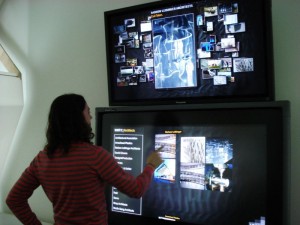
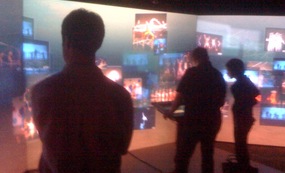
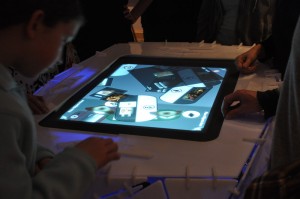
The IDIA has assembled an interdisciplinary group of students, faculty and industry experts in a significant interactive information portal for the Ball State University Museum of Art (BSUMA).  The IDIA team is developing an innovative touch-based interface to navigate the collection, employing and integrating Microsoft Surface with the Museum’s database.  The Surface will afford Museum patrons a collaborative, participatory public platform through which to access metadata and media of the physical exhibition – as well as extending virtually into the permanent collection. Using the Digital Images Delivered Online (DIDO) database, the interface will make visual the interconnection between works in the collection queried on searchable parameters, i.e. artist, medium, period, subject etc. This two-semester immersive project supported by the BSU Provost’s Immersion Initiative has been team-taught and has recruited students from targeted disciplines across campus.

Complete Instruction Guide here: http://ilocker.bsu.edu/users/idiaa/world_shared/SurfaceInstructions.pdf

Microsoft Surface represents a fundamental change in the potential for interaction with digital content. The Surface is a 30” tabletop interface environment that allows several people to work independently or collaboratively – all without using a mouse or a keyboard.  The Surface allows users to navigate information physically, and manipulate information with natural gestures and touch http://www.microsoft.com/SURFACE/product.html#section=The%20Product.

The Ball State University Museum of Art has a collection of nearly 11,000 works of art. Central to the Ball State University Museum of Art’s purpose is the provision of educational programming that will further faculty, staff, student, and public utilization and understanding of the Museum and its collection, of museums in general, and of the arts. To accomplish this goal, the Museum offer tours, talks, materials for teachers, an education database, artist demonstrations. The Museum’s education philosophy centers on bringing together the needs of visitors and the resources of the Museum , and balancing responsibility to the university with service to the community. In facilitating communication between the work of art and the viewer, the Museum subscribes to a philosophy of learner-centered programming informed by a thorough knowledge of the collection and methods and strategies for effective teaching.

Although the Museum’s collection numbers nearly 11,000, given the physical constraints of the facility, a mere 10% of the collected works are currently displayed at any given time.  The incorporation of this hybrid Surface and database system will afford patrons virtual access to the entire collection – making visible those works currently stored.  More importantly, the system will allow patrons to visualize the interconnectivity of the works according to multiple facets – visually re-contextualizing the works in relation to specified search parameters.  This form of innovative technology within a museum context would typically be installed at major metropolitan institutions. Development of this interface at the Ball State University Museum of Art will not only benefit local community groups and patrons of BSUMA whose access to the collection will be significantly augmented, but also has the potential to influence other museums through the distribution of the outcomes of this product.

The Institute for Digital Intermedia Arts (IDIA) has a history of providing interdisciplinary immersion and new media experiences, employing pedagogy that supports students’ transformation as active, engaged learners. The Institute provides a dynamic exchange between instructor and students – where participants engage in collaborative, inquiry-based communities that provide an environment, which fosters participatory learning. As opposed to a traditional model, where knowledge is imparted by the teacher to the student, participatory learning can transform the learner into an active role. Participatory learning communities engage in a dynamic conversation centered around a subject – where analysis, comparison, and evaluation are core to the process of acquiring meaning and relationships. This environment allows students the opportunity to have a stake in the conditions of their learning, making decisions that direct their course of investigation. With a commitment to active inquiry, participants are freed to create personal and collective meaning.


BSU MUSEUM OF ART

COLLECTION PORTAL

SOFTWARE DESIGN

Carrie Arnold

Joel Happ

Garret Orth

Deekshita Reddy

Christopher Ross

Jonathan Strong

Austin Toombs

INTERFACE DESIGN

Anastasia Goryacheva

Steven Lanier

Jonathan Strong

ELECTRONICS

Eric Brockmeyer

Giovanni Rozzi

GRAPHIC DESIGN

Amy Goettemoeller

Ina-Marie Henning

FACULTY

Jesse Allison

John Fillwalk

Paul Gestwicki

PROJECT DIRECTOR

Jonathan Strong

A SPECIAL THANK YOU

UNIVERSITY LIBRARIES

James Bradley

John Straw

Budi Wibowo

SOUND

Rick Baker

Steven Lanier

Giovanni Rozzi

STRUCTURAL DESIGN

Eric Brockmeyer

Matthew Wolak

PROJECT MANAGEMENT

Ina-Marie Henning

Amruta Mhaiskar

Jennifer Weaver-Cotton

PRODUCER/PRINCIPLE INVESTIGATOR

John Fillwalk

BALL STATE UNIVERSITY MUSEUM OF ART

Peter Blume

Carl Schafer

Tania Said

Ball State University Museum of Art

College of Fine Arts

College of Architecture and Planning

Department of Architecture

Department of Art

Department of Computer Science

School of Music

Information Technology

Office of the Provost

University Libraries

and

Jeff Berg, IBM Interactive, IDIA Research Fellow

IDIA Presents: BSU MUSEUM OF ART COLLECTION PORTAL 3/20/11 at 2:30pm BSUMA


BSU MUSEUM OF ART COLLECTION PORTAL
Reception and Gallery Talk

Thursday, March 20 @ 2:30pm, BSU Museum of Art

The BSU Museum of Art Collection Portal was developed by students, faculty and industry research fellows in the Institute for Digital Intermedia Arts at Ball State University. The year-long project was developed in partnership with the Ball State University Museum of Art and sponsored by the Provost’s Immersive Learning Initiative.

This interdisciplinary team from art, computer science, architecture and music has developed an innovative, touch-based application to navigate the collection. The portal bridges the Microsoft Surface interface with the Museum’s collection database, the Digital Images Delivered Online (DIDO), hosted on the Digital Media Repository of Bracken Library. The Surface affords Museum visitors an interactive platform to individually or collaboratively make virtual connections between works of art both on display and in reserve – accessing information and media across the collection.

http://bit.ly/IDIA_Surface

Complete Instruction Guide here: http://ilocker.bsu.edu/users/idiaa/world_shared/SurfaceInstructions.pdf

Microsoft Surface Museum Collection Portal: IDIA Presents: BSU MUSEUM OF ART COLLECTION PORTAL 3/20/11 at 2:30pm BSUMA

IDIA Presents: BSU MUSEUM OF ART COLLECTION PORTAL 3/20/11 at 2:30pm BSUMA
BSU MUSEUM OF ART COLLECTION PORTAL
Reception and Gallery Talk
Sunday, March 20 @ 2:30pm, BSU Museum of Art

The BSU Museum of Art Collection Portal was developed by students, faculty and industry research fellows in the Institute for Digital Intermedia Arts at Ball State University. The year-long project was developed in partnership with the Ball State University Museum of Art and sponsored by the Provost’s Immersive Learning Initiative.

This interdisciplinary team from art, computer science, architecture and music has developed an innovative, touch-based application to navigate the collection. The portal bridges the Microsoft Surface interface with the Museum’s collection database, the Digital Images Delivered Online (DIDO), hosted on the Digital Media Repository of Bracken Library. The Surface affords Museum visitors an interactive platform to individually or collaboratively make virtual connections between works of art both on display and in reserve – accessing information and media across the collection. Special thanks to IDIA Research Fellow Jeff Berg from IBM Interactive!

http://bit.ly/IDIA_Surface


BSU MUSEUM OF ART

COLLECTION PORTAL

SOFTWARE DESIGN

Carrie Arnold

Joel Happ

Garret Orth

Deekshita Reddy

Christopher Ross

Jonathan Strong

Austin Toombs

INTERFACE DESIGN

Anastasia Goryacheva

Steven Lanier

Jonathan Strong

ELECTRONICS

Eric Brockmeyer

Giovanni Rozzi

GRAPHIC DESIGN

Amy Goettemoeller

Ina-Marie Henning

FACULTY

Jesse Allison

John Fillwalk

Paul Gestwicki

PROJECT DIRECTOR

Jonathan Strong

A SPECIAL THANK YOU

UNIVERSITY LIBRARIES

James Bradley

John Straw

Budi Wibowo

SOUND

Rick Baker

Steven Lanier

Giovanni Rozzi

STRUCTURAL DESIGN

Eric Brockmeyer

Matthew Wolak

PROJECT MANAGEMENT

Ina-Marie Henning

Amruta Mhaiskar

Jennifer Weaver-Cotton

PRODUCER/PRINCIPLE INVESTIGATOR

John Fillwalk

BALL STATE UNIVERSITY MUSEUM OF ART

Peter Blume

Carl Schafer

Tania Said

Ball State University Museum of Art

College of Fine Arts

College of Architecture and Planning

Department of Architecture

Department of Art

Department of Computer Science

School of Music

Information Technology

Offi­ce of the Provost

University Libraries

and

Jeff Berg, IBM Interactive, IDIA Research Fellow

IDIA Students Present Surface Project to IBM

As a follow-up to last week’s conference with IDIA Research Fellow Jeff Berg, IBM, John Fillwalk and IDIA Immersion Seminar students were invited to present our Microsoft Surface interface project to a 10 member IBM Interactive team made up of designers and programmers based in Chicago. Provost’s Immersive Learning Grant funded the pursuing commercialization of this product.

Flickr Gettr

At its essence, Flickr Gettr is a novel virtual interface bridging the virtual worlds to the wealth of shared real life imagery and information in Flickr.

Currently on Display at the New Media Consortium, amongst others: http://slurl.com/secondlife/NMC%20Campus%20West/137/100/21

USAGE

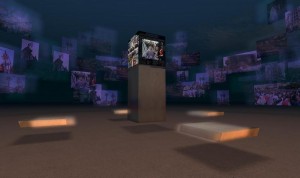
Participants query to search public image folders at Flickr web-service. Queries pulls related images from Flickr and feeds them back to be spatialized in an immersive visual and sonic environment.  As each image spawns, it generates a chime-like sound which parallels the environment of imagery that surrounds the viewer.

In Flickr Gettr II, a participant can touch any image and receive a list of the tags associated with it.  Touching the same image again initiates a random search for one of those tags thus retrieving similar imagery.

In Flickr Gettr, an external web service was used as an intermediary to query Flickr, receive images and format them for delivery as a texture.  It then passed the aspect ratios and tags in a second query to be able to map the textures properly.  To make these interactions more flexible, the intermediary web server was employed to collate and prepare information to retain states that can be queried from external applications.  The web application effectively serves as an intermediary between the virtual world and outside environments, providing the communications link and logic to assimilate the information.  This can make the creation of Web 2.0 mash-ups much simpler as the code for doing these sorts of queries and logic is already highly developed in Java, Ruby, and Perl for example.  Flickr Gettr also triggered music files upon the rapid rezzing of objects to create a cumulative ambient effect.

Twitter Cloud

The Twitter Cloud is a visualization of real time Tweets (messages) posted on Twitter.com. The system automatically scans specified user feeds, and visualizes new messages as they arrive. This piece was programmed in Java using the Processing API.

This project was also linked with the Tweet Station so users could be identified with RFID and allowed to post their own messages through a touchscreen kiosk. In the context below, conference attendees entered their Twitter feeds to be tracked so that others could read about their experiences as they posted from their laptops and phones. The Twitter Cloud visualizer has also been used within virtual worlds – both as a live event Tweet tracker, and to track and visualize avatars as they traveled to various locations within the world.

Human-Computer Interaction in the Arts

The Human-Computer Interaction Lab housed in Music Technology is a learning and exploration ground in how electronics can interact with the arts. Students who take the MuMET 440 Special Topics course in HCI can use the lab to develop projects in augmented musical instruments, electronic installation art, analog audio processors, synthesizers, robotics, wireless sensor systems, and other electronic mayhem.  The course teaches equal parts basic electronics like power regulators, op amps, etc. and programming techniques for microcontrollers – the TI MSP430 and the Arduino. Most of all, the lab serves as a proving ground for ideas and a space for exploration.

Traversal

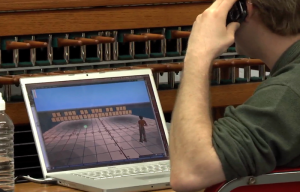
Traversal for Pipe Organ is a virtual performance exploring connectivity between worlds. As the name implies, it is a temporary link between the live pipe organ in a concert hall and a multi-user virtual world. “Physical” actions and events in the virtual realm compose the work in real time with the end product being a physical and aural realization of virtual performance.
As elements of the virtual instrument were engaged, their physical interactions – touch, physics, collision events – were used to create performance gestures on the organ in Sursa Hall. John Fillwalk, who had created the performance environment and virtual instrument as well as collaboratively conceptualized the work, performed live camera for the event that followed the performance for the live audience.  Jesse Allison composed the controllable sound events, and managed the communications link between the virtual and physical during the performance.

Excerpt from the premier performance.

Eco-Net

“Eco-Net” is an attempt to connect wireless network data with nature by visualizing that data with plant-like structures and organic motion. Each plant represents a computer connected to the network and each IP address is displayed above the corresponding plant. Collective network activity is displayed as websites are browsed and emails are sent. This piece represents our constantly connected state, simulated through plant and root structures, and the constant barrage of data that flows through the air all around us every day. This piece was created completely in Java, using the Processing API.

Links
Students win international award for work in the digital arts

Engaging Technology Exhibition

ENGAGING TECHNOLOGY A HISTORY AND FUTURE OF INTERMEDIA BALL STATE UNIVERSITY MUSEUM OF ART NOVEMBER 17, 2006 THROUGH MARCH 11, 2007 https://idialab.org/engagingtechnology/ Engaging Technology traces a range of both pioneering and contemp-orary works exploring the intersections of electronic media and various modes of art-making. The artists selected for this exhibition – Richard Bloes,

RFID-Linked 3D Media Interface

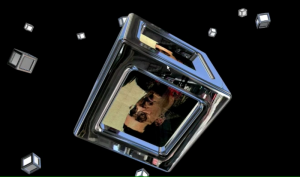
The project allows the user to manipulate a digital world with wireless objects. Through the use of Radio Frequency Identification Devices (RFID), the virtual world can detect the presence of real-world objects and use them to manipulate its own attributes. In the case of this project, physical cubes link the user with virtual cubes within the system and allow the user to call up media such as video and sound. The system uses the software Quest 3D for real-time VR rendering and interactive animation, and Max/MSP for harvesting and inputting RFID data. Additionally, users can navigate the 3D virtual world with the use of a trackball.

Students participating in IDIA’s Immersion Seminar were named as a winner for an Award of Excellence at the International Digital Media and Arts Association (iDMAa) 2007 National Conference. The award included a $250 cash prize and was presented to only two groups out of the twelve universities participating in the conference’s student showcase. iDMAa hosted the Ideas 07: Beyond Boundaries conference in Philadelphia on November 7-11.

Links
BSU Press Release
2007 iDMAa Conference Website
iDMAa Homepage

MMFX/IMA Interactive Project

IDIA is creating a media rich interactive digital kiosk for the Digital Fabrication Institute’s MMFX Exhibit hosted by the Indianapolis Museum of Art. Students participating in the IDIA Immersion Seminar in Virtual Worlds are developing the interactive interface, which will act as a station within the exhibit where viewers can attain additional biographical and portfolio information– employing a custom designed, coded and fabricated dynamic media experience.

[un]wired

[un]wired by Jesse Allison, John Fillwalk and Keith Kothman is a processing network visualizer that responds to interactions from personal radio-frequency devices such as mobile phones, WiFi signals, Bluetooth signals and car-key fobs. It tracks real-time statistical information from wireless access points (designed for seamless handoff of moving wireless traffic, like a cell phone network), along with periodically updated information from hand-held and wireless access points. The interactions then appear in sound and shapes on the screen. Users interacting with the piece can then visually see their interaction live on screen. The control information is collected from network services via the MySQL database and transferred into Max/MSP/Jitter. [un]wired was exhibited at SIGGRAPH Asia 2008 in Singapore.

http://www.siggraph.org/asia2008/attendees/art/20.php

Intermedia Artist Timeline

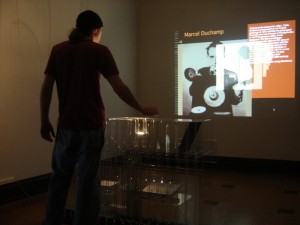
This device was designed to take you on a journey through the history of intermedia art. The kiosk, made by the IDIA in collaboration with the Institute for Digital Fabrication at Ball State University, allows the user to interact using hand gestures to move through the timeline. The work includes a short bio, image and description of works from 30 intermedia artists of the 1960s to the present. It was displayed in conjunction with the BSU Museum of Art’s Engaging Technology Exhibit. Jesse Allison programmed the piece with help from Mike Sayre. Dustin Headley and the IDF designed and constructed the kiosk.

interActivity: IDIA at Philips HighTech Campus during Dutch Design Week

TRAVERSAL FOR EINDHOVEN
during Dutch Design Week

Collaboration with IDIA Lab and MAD Emergent Art Center

IDIA Lab
John Fillwalk and Jesse Allison

MAD Emergent Art Center Rien Daamen and Réné Paré

October 17-25, 2009 15-21 SLT live daily through the 25th

Virtual location
http://slurl.com/secondlife/Ball%20State%20University2/181/128/21

Physical location: Philips HighTech Campus and NatLab in Eindhoven, Nederlands
http://www.hightechcampus.nl/

‘Traversal for Eindhoven’ is a live performance / hybrid reality installation that bridges the physical and virtual worlds. It connects Philips NatLab in Eindhoven to a virtual environment as part of the 2009 Dutch Design Week. Avatars will be able to perform a physical synthesizer in the Philips NatLab via an interactive online virtual instrument built by IDIA – located near a 3D model of the Eindoven High Tech Campus. The sound of the live synthesizer will be streamed back into Second Life, so the virtual and physical participants can hear their interactions with the instrument.

DUTCH DESIGN WEEK From October 17 through October 25 2009, Eindhoven presents the 8th edition of Dutch Design Week, the largest design event in the Netherlands. Around 1500 designers from home and abroad will show their work in more than 60 locations all over the city of Eindhoven from design disciplines such as industrial design, concept design, graphic design, textile & fashion, spatial design, fooddesign and design management & trends. Visitors will be given insight into the entire development process from concept to product in various disciplines ranging from industrial design to applied arts. The participants include established bureaus, high-profile designers, talented newcomers, and recently graduated designers, one of the reasons why this Dutch Design Week is the perfect meeting place for designers, companies, and public. http://www.dutchdesignweek.nl/indexmap.php

MAD EMERGENT ART CENTER The Foundation MAD is a platform and workshop for Emergent Art: art that exists in the exiting world between cultural and cutting edge technological developments.MAD emergent art center is laboratory, platform and provider on the intersection of art, science and technology. MAD addresses artists, designers, scientists, public groups, institutions, governments and businesses. This on regional as well as national and international level. http://www.mad.dse.nl/mad.html
More Information: http://tinyurl.com/yl2dq4l

interActivity: Between Two Worlds:Virtuality in Arts and Teaching

Between Two Worlds:Virtuality in Arts and Teaching

John FillwalkBall State University
Jesse AllisonBall State University

Abstract

Virtual worlds provide a platform in which to construct compelling experiences not possible within the material and temporal constraints of the physical world. The virtual realm has the potential to be united and engaged by physicality–informing and transforming the audience’s experience of exhibition in a profoundly transformative nature. The Institute for Digital Intermedia Arts at Ball State University has been incorporating mixed-reality approaches into museum exhibitions, musical performances, installation art, and interface over the last several years. This paper documents specific explorations of the opportunities of the Second Life environment for mixed-reality experiences–analyzing approaches to bridging the worlds such as media streaming, client-side interaction, an external web server communication hub, as well as opportunities for human/computer interaction.


More Information: http://aisel.aisnet.org/mg2009/6

IDIA Blackboard Greenhouse Grant for Virtual Worlds: IDIA Present Blackboard/SL Greenhouse Grant for Virtual Worlds at Blackboard World 2009

Blackboard Greenhouse Project for Virtual Worlds: The IDIA Second Life/Blackboard Building Block Project
BbWorld ’09
7/15/2009 12:00 PM – 12:45 PM
National Harbor 2

Theme
Expanding and Improving Online Learning, Strategic Initiatives

Special Topics
Featured Speaker(s), Openness and Extending Blackboard Software

Speakers
John Fillwalk, Director of the Institute for Digital Intermedia Arts, Ball State University
Session Description
Ball State University’s Institute for Digital Intermedia Arts (IDIA) has produced a bridging toolset, linking the multi-user virtual environment of Second Life with Blackboard Learn – providing a unified, secure and fluid hybrid learning experience. This project is funded by the Blackboard Greenhouse Grant for Virtual Worlds and has produced an open-source Building Block.

IDIA at Ball State University (BSU) created a virtual and web-based software toolset to manage, administrate and facilitate any hybrid Second Life / Blackboard Learn instructional experience. These Blackboard Building Blocks and Second Life scripts were specifically developed for a “hands-on” cinematography course taught with a complete set of virtualized filmmaking equipment. This pilot course also served as a prototype for Blackboard courses from any discipline that uses Second Life – especially in the delivery of studio, laboratory or other hands-on modes of learning – extending the modes of typical distance-learning offerings. The pairing of Blackboard technology augments Second Life as is not designed with course management tools to operate effective self-contained distance instruction.

Join us for a discussion of these tools, released by IDIA, which have resulted in the public availability of Blackboard Building Blocks that facilitate automated communication between Blackboard Learn and Second Life, and more generally, the conceptual template for using Blackboard Learn to manage virtual world creation, access, and activity in Second Life.For more information-http://www.nmc.org/files/ACUTA_Article_SecondLife.pdfhttp://www.bsu.edu/news/article/0,1370,-1019-61661,00.html

http://campustechnology.com/articles/2008/03/bsus-entry-into-second-life-is-grounded-in-emerging-media-expertise.aspx

http://campustechnology.com/articles/2008/08/2008-campus-technology-innovators-virtual-world-learning.aspx

http://www.acuta.org/wcm/acuta/pdf/iea2010_brochure.pdf

http://www.blackboard.com/Company/Media-Center/Press-Releases/Archive.aspx?releaseid=1109469

More Information: http://www.bbworld.com/2009/bbworld/content.asp?id=1487

IDIA is now an official Blue Mars Developer

Blue Mars is a free to play massively multiplayer virtual world featuring stunning graphics, realistic characters, and endless social bonding activities. The Blue Mars virtual world is made up of an expanding set of independently operated cities that feature unique themes, activities, and attractions such as shopping, avatar customization, unique personal spaces, and games like dancing, racing, and golf. Cites on Blue Mars are tied together with a unified login system, persistent global Avatar ID, and platform wide participation based reward system.

More Information: http://www.bluemarsdev.com/

Motion capture summer animation project by “Third Floor Studios”

Andy Beane has formed a large summer class with many students with different academic majors and skill sets to come together and make a finished animated short. IDIA’s Trevor Danehy assisted the class in creating their workflow pipeline with the integration of motion capture. The class, which named themselves ‘Third Floor Studios (on account that most of the work takes place on the third floor of the Arts and Journalism  building), wanted to use motion capture to assist them in animating characters due to the rather small amount of time the summer session allots for them. Motion capture is the process of recording a live person’s physical movements and transferring them to data that can be applied to an animated character. Ball State’s Biomechanics Laboratory provided the motion capture facilities and equipment to capture the actor’s movements. Trevor Danehy helped line the workflow in binding the tracking point data to an animated character’s digital skeleton, using programs such as Autodesk Maya and Motionbuilder. A concentration on keeping the software pipeline as minimal as possible is pivotal to creating an animated short in a set timeframe.

Virtual World/Social Media Mashup: Flickr Gettr v4

IDIA Lab’s new Flickr Gettr launching soon – shared & mobile virtual world mashup artwork – preview Flickr pics here http://bit.ly/bCWQCL

Flickr Gettr: Shared and Mobile Media Mashup Artwork
Virtual World/Social Media Mashup: Flickr Gettr v4
The Institute for Digital Intermedia Arts (IDIA Lab) at Ball State University

IDIA Labs Flickr Gettr connects the social image repository of Flickr to virtual worlds and mobile devices through an interactive 3D and sonic experience – immersing the viewer in a dimensional cloud of user searched imagery and sound.

Background

Flickr Gettr in Second Life, leverages the new SL shared-media plugin architecture to provide rich spatially integrated web experiences. Participants query to search public image folders at the Flickr web-service. Queries then pull in related images from Flickr and feeds them back to be spatialized in an immersive visual and sonic environment.  As each image spawns, it generates a sound which parallels the environment of imagery that surrounds the viewer in their selected imagery and related tags that are spoken in synthesized voice.

Flickr Gettr positions virtual worlds as a platform to navigate media in the information metaverse. Virtual worlds have the potential to position the Internet as a three-dimensional information and communication platform where live data can flow in and out to visualize, contextualize, communicate, and to inspire.

In Flickr Gettr, an external web service was used as an intermediary to query Flickr, receive images and format them for delivery as a texture.  It then passed the aspect ratios and tags in a second query to be able to map the textures properly.  To make these interactions more flexible, the intermediary web server was employed to collate and prepare information to retain states that can be queried from external applications.  The web application effectively serves as an intermediary between the virtual world and outside environments, providing the communications link and logic to assimilate the information.  This can make the creation of Web 2.0 mash-ups much simpler as the code for doing these sorts of queries and logic is already highly developed in Java, Ruby, and Perl for example.  Flickr Gettr also triggered music files upon the rapid rezzing of objects to create a cumulative ambient effect.

In 2010, IDIA Lab was invited by the Indian Institute of Technology in Mumbai, India to to install Flickr Gettr at the their annual technology festival – the largest of its kind in Asia – which hosted more than 65,000 attendees.

Testing Shafer Bell Tower

Members of the IDIA spent the afternoon testing Ball State’s Shafer Tower in order to connect it to the virtual worlds.  The testing is in preparation for an upcoming outdoor event allowing people to perform the Carillon bells via Second Life.

Traversal for Boston Cyberarts

Traversal for Boston Cyberarts was a live performance and hybrid reality installation that bridged the physical and virtual worlds. It connected Faneuil Hall in Boston with a bell tower with midi controlled carillon as part of the 2009 Boston Cyberarts Festival.

Virtual participant could perform the physical bell tower via an interactive online virtual instrument built by IDIA – located in a 3D model of Faneuil Hall. Participants from all over the world could play the actual French carillon on top of Shafer Tower via their avatars. The ringing of the bells of Shafer Tower was streamed and simulcast back into Second Life, so the virtual participants can see and hear their interactions. Participants at Shafer Tower could also connect to their virtual counterparts through technology set up at the base of the tower and perform the bells locally through the same virtual interface.

IDIA collaboratively designed and built this interactive artwork for the Boston Cyberarts Festival.


Links

Boston Cyberarts

Boston Cyberarts Gallery

Virtual Reality Brings Interactive, Immersive Art to the 2009 Festival

AM Radio: The Red and The Wild at IDIA Labs in Second Life

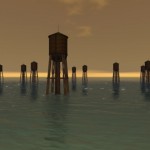
A group of tall, wooden water towers stands in shallow water under a cloudy, orange sky at sunset.

AM Radio’s The Red and the Wild Opening Reception Sunday, April 26th 2009 7 pm SLT

IDIA is pleased to host artist AM Radio as the inaugural artist-in-residence at IDIA Labs – an exhibition and installation sim for virtual installation art and performance. IDIA hosts AM Radio’s The Red and the Wild as the inaugural artist-in-residence at IDIA Labs, an exhibition and installation sim for virtual art.

The Red and The Wild is an experimental shift in my work. The Red and Wild has its basis in earlier builds, notably Husk and Beneath the Tree that died. This time, a third house structure appears, based on a house which figures strongly in my childhood memories. The train that appears as a symbol in many of my works returns, but revived. A doorway represents an impossible or at least implausible path. Water towers dot the horizon, displaced in the context of an over abundance of water. A large red shape looms over the water and into or out of the house.

The title itself has its origins in a film and music artist friend from Atlanta. He had sent me a collection of music experiments of his just as I was in the midst of trying to understand why I was feeling a need to bring in abstract and maybe creepy shapes into my work. One of the tracks sampled some audio from the movie Breakfast at Tiffany’s. The audio lead me to watch the film again and read Capote’s Novella. In the story, the main character Holly invents a world around her in reaction to her anxieties and fears which she describes as the “mean reds.” Holly says, “But you can’t give your heart to a wild thing: the more you do, the stronger they get. Until they’re strong enough to run into the woods. Or fly into a tree. Then the sky. That’s how you’ll end up, Mr. Bell. If you let yourself love a wild thing. You’ll just end up looking at the sky ”

-AM Radio

THE INSTITUTE FOR DIGITAL INTERMEDIA ARTS is a hybrid art and design studio established as part of the Center for Media Design at Ball State University and funded the Lilly Endowment, Inc. The institute’s interdisciplinary studio collaborative explores the intersections between arts and technology – employing virtual reality, visualization, simulation and human computer interface.

Slurl: http://slurl.com/secondlife/IDIA%20Laboratories/15/134/21

Links:

SL Things To Do

DIP’s Dispatches from the Imagination Age

Digital Cinema Arts in the Virtual World, The Aesthetic Camera Project: IDIA Receives Institutional Excellence Award

Ball State University has won yet another real-life national honor for one of its Second Life initiatives.

The Institute for Digital Intermedia Arts (IDIA) has earned a 2009 Institutional Excellence in Information Communications Technology Award from ACUTA, the Association for Information Communications Technology Professionals in Higher Education.

The organization will formally present the honor to John Fillwalk, IDIAA director and associate professor of electronic art, at its annual conference April 19-22 in Atlanta. The award recognizes IDIAA for its Aesthetic Camera filmmaking course and integrated Blackboard custom software, offered through the online world of Second Life.

The course teaches cinematography techniques and allows students to gain hands-on experience with equipment and resources that might not ordinarily be available to them. Within the virtual studio, they can check out cameras, dollies, light systems and more to create their own original movies. They can also film using avatars in costume in a wide variety of virtual set locations.

“Ball State’s Aesthetic Camera is a superb example of the type of innovation that ACUTA’s Institutional Excellence Award is designed to recognize,” said Walt Magnussen, ACUTA’s immediate past president and awards committee chairman. “This blending of virtual learning and distance education leverages the best of both the IT and the telecommunications disciplines.”

When first launched, the Aesthetic Camera course received Blackboard Inc.’s inaugural Greenhouse Grant for Virtual Worlds for its work linking the interactive technology of Second Life and Blackboard, which produces Web-based, course management software. The award cited the innovative combination, which allows Ball State to extend virtualized studio and laboratory experiences to an online distance education audience.

The course’s equipment has been virtualized and scripted, which means that it is quite similar to its real-world counterparts, Fillwalk said.

“Preparing our students for a changing world through immersive learning opportunities is a top priority for Ball State,” he said. “The IDIAA is leveraging Ball State’s success in emerging media and creating innovative media art and design experiences for our students in both real and virtual environs.”

The Aesthetic Camera and other opportunities available at the IDIAA are part of Ball State’s Emerging Media Initiative, a planned $17.7 million investment to accelerate economic benefits to Indiana with media-savvy human capital.

More Information: www.acuta.org

You, Me and the Bee: An Interactive Children’s Exhibit

The students of the 2009 spring seminar at the Virginia Ball Center launched their interactive children’s exhibit at the Minnetrisa Center on April 17th. The exhibit is designed for elementary children to gain a better understanding of honeybees and the significant role they have in our world. Through the Human Computer Interface lab sponsored by the IDIA, students were able to design and implement the interactive aspects of the exhibit which will remain at Minnetrista through August.

More Information: http://bsu.edu/youmeandthebee/You,%20Me%20%26%20the%20Bee/Homepage.html

Las Americas Virtual Design Studio: Las Americas Finalist for 2009 Mira Award

TechPoint Releases Nominees for 2009 Mira Awards Presented by BKD

Record Number of Entries Proves Challenging for Independent Judging Panel

Winners and Finalists for the 2009 Mira Awards presented by BKD will be revealed on May 16, at the awards gala, but TechPoint has released the names of 83 companies, schools and individuals from around the state nominated in 11 different competitive categories.

According to TechPoint President and CEO Jim Jay, the Mira Awards planning committee received more nominations this year than in any other year since the program’s inception 10 years ago.

Three independent panels of judges made up of business and community leaders were tasked with evaluating the 83 nominations in 11 different categories. The finalists and winners will be revealed at the 2009 TechPoint Mira Awards Gala presented by BKD on May 16, which will be held at The Westin Hotel in downtown Indianapolis.

Mira Award

Las Americas Virtual Design Studio: Design Communication Conference Presentation

The 2009 Design Communication Conference was held in Atlanta, Georgia from March 25-28th.  This years conference theme is ‘Bridging Communication’ and featured a paper presentation from Antonieta Anguio titled “Collaborating in a Virtual Multiuser Environment: The Virtual Design Studio Populates Second Life.”  The presentation included the project Las Americas.

More Information: http://designcomm.org/DCA08/IndexDCA2009.htm

Muncie Robotics Team Wins Regional Animation Award

Muncie/Delaware Robotics PhyXTGears Team 1720 was given the Autodesk Visualization Award March 20 during the FIRST Robotics Regional Competition at Purdue University for an animated film they created. For those who wish to see the winning Animation video:  http://www.youtube.com/watch?v=RD-gbbC1kCc

Each year, Autodesk, Inc. recognizes excellence in student animation that “clearly and creatively illustrates the spirit of the FIRST Robotics.” FIRST (For Inspiration and Recognition of Science and Technology) is an organization affiliated with NASA, that inspires and motivates high school students to become interested and involved in science and technology. FIRST robotics competitions are held annually on the regional and national level.

PhyXTGears produced a 30 second animated film for the FIRST theme “Using Biomimicry for Sustainability”, which promoted the benefits of “Gecko Tape.” Don’t go looking for it at the local hardware store.  “The gecko-based non-chemical adhesive is currently being developed at several universities,” said Eric Jiang, one of the team members who worked on the animation project. Other members of the group include Jackson Eflin, Emily Kao, Morgan Moncada, and Shelby Smith, led by mentor Andy Beane(IDIAA Faculty Fellow), of BSU’s Department of Art.  This was the 2nd Autodesk Visualization Award for Team 1720 in the team’s 4 year tenure.

Last weekend, March 20-21 was PhyXTGears’ first official competition of the new year. Thirty-five teams from Indiana, Illinois, Ohio and Kentucky gathered at Purdue to play in the 2009 game challenge called “Lunacy”, in honor of the 40th anniversary of NASA’s success of landing a man on the moon.

Of the 35 teams present, at the end of the qualifying matches, Muncie’s own ranked #1!  Teams play best 2 out of 3 for the Elimination rounds. The third and final match was a close game. When time ran out, the two alliances were tied at 60 points each. A break was taken while the judges recounted the points. After several minutes wait, the official score was announced, 60 to 62. PhyXTGears lost the 3rd match by only 2 points. You can’t get much closer than that!  Team 1720 ranked #7 overall after the Elimination rounds.

Links:
Robotics Team Homepage
Ball Bearings Story: A Well Oiled Machine

More Information: http://muncierobots.iweb.bsu.edu/gallery/2009/Boilermaker.html

LoVid Performance

LoVid is the New York based interdisciplinary artist duo Tali Hinkis and Kyle Lapidus. Their work includes live video installation, sculptures, digital prints, patchworks, media projects, performances, and video recording. They combine many opposing elements, contrasting hard electronics and soft patchworks; handmade items and machine produced objects; and analog and digital. LoVid has performed, exhibited, and lectured at The Museum of Modern Art, Neuberger Museum, PS1, The Butler Institute of American Art Evolution Festival (UK), The Kitchen, Kansas City Art Institute, Chicago Art Institute, The New Museum of Contemporary Art, and the Institute of Contemporary Art London among many others. LoVid has been part of the artist in residence program at Eyebeam, Harvestworks, iEAR, Alfred University, and Stevens Institute of Technology, has has received grants and awards from Experimental TV Center, NYSCA, Foundation for Contemporary Arts, and the Greenwall Foundation.

More Information: www.lovid.org

Interactive Artworks Showcase at the Ball State Indianapolis Center

February 25th

Interior screens:
Bounding Box
Jesse Allison, Interactive design
John Fillwalk, Visual design

Bounding Box is a live, digitally processed installation designed to be driven by public interaction and incorporates live video from the interior of the BSU Indianapolis Center. Participants’ movements in the local environment manipulate the virtual water and cause the moving box to move within the frame. You can literally play the piece by positioning your body in front of the four screens. The more vigorous the movement, the more turbulent the liquid becomes.

Exterior screens:
The Tempus Series:
Oriens I, II, III;  Meridian IV, V, VI;  Nox VII, VIII, IX

Jesse Allison, Interactive design
John Fillwalk, Visual design

The Tempus Series transforms viewers’ gestures into flowing movements of nine compositions –movement, colors, textures, and forms dynamically shift amongst passages in the series. Camera tracking follows live motion in front of the street-side display, allowing for the direct influence of the composition by passers-by and traffic. This large series of works rotates through three sets of passages during the morning, afternoon and evening hours.

Presentation at the LSU Mardi Conference 2009

John Fillwalk presented recent IDIA research in virtual worlds at the 2009 Mardi Gras Conference. Fillwalk and Allison, together with the IDIA, have been exploring hybrid-reality approaches to their work in pedagogy, performance, installation, and interface over the last several years at BSU. They have incorporated approaches to bridging worlds in such applications as streaming media, external webserver communications, and human-computer interaction.

The LSU Center for Computation & Technology , in cooperation with the LSU Arts, Visualization, Advanced Technologies and Research (AVATAR) Initiative , is hosting the 16th annual Mardi Gras Conference, February 19-21, 2009, in Baton Rouge, Louisiana. The Mardi Gras conferences take place annually, concentrating each year on a different computational theme of current relevance. This year’s theme will be: “Virtual Worlds: New Realms for Culture, Creativity, Commerce, Computation and Communication.” As always, the conference concludes with an afternoon trip to New Orleans for one of the city’s largest Mardi Gras parades, Endymion.

Although the concept of virtual worlds has deep roots within the world of networked computing, it is only within the past few years that virtual worlds have captured the imagination of so many in such diverse fields as art, music, business, philosophy, psychology, sociology and mass communication. Moreover, there have been very few events that have tried to organize a broad interdisciplinary perspective around virtual worlds, their adoption by various constituencies, and their use by artists, musicians, historians, designers, educators, archivists, computer scientists, gamers, businesses and entrepreneurs.

The 2009 Mardi Gras Conference will bring together individuals working in this broad area in an attempt to foster information exchange, enable community building and project future trends across the multitude of disciplines that have engaged this technology. This event can be seen as a follow-on to the Emory University workshop in February 2008 on “Virtual Worlds and New Realities in Commerce, Politics, and Society.” The 2009 Mardi Gras Conference will feature workshops on the various technologies, panels, posters and papers in addition to several invited keynote speakers.

More Information: http://www.mardigrasconference.org/

Las Americas Virtual Design Studio: AIArchitect: Architecture In Second Life Is a World All Its Own

The online interactive software program Second Life has become an emerging place of architecture research that ranges from a practice tool to an open-ended exploration of design context and expression. Especially in architecture schools, its immersive 3D environments allow users to conceptualize and design a space quickly, thus opening it up for investigation by other users, which allows designers to see how it will be used and how people will circulate through it.

Vasquez de Velasco and his students have been using Second Life to design a hotel and surge hospital with the Las Americas Network. Proving Second Life’s ability to obliterate geographic distances, Las Americas is composed of students from Ball State and from 30 architecture schools across Latin America. Ball State’s Institute for Digital Intermedia Arts and Animation (IDIAA) helped to execute Las Americas design ideas, while BSA Lifestructures, an Indianapolis firm with a robust health-care practice, reviewed and evaluated students’ work.

More Information: http://info.aia.org/aiarchitect/thisweek09/0220/0220d_secondlife.cfm

2nd Annual Robotics Scrimmage

High school robotics teams from all over Indiana have been invited to participate in the 2nd annual practice scrimmage Sunday, Feb. 15, from 1 – 5 p.m. at the Ball Gym, Ball State University, to see how well their robots will perform during national competitions later this year. This event is hosted by PhyXTGears, Muncie’s Robotics Team #1720, comprised of high school students from Delaware County. The public is invited to attend the event, parking is free. For directions, visit www.bsu.edu/map/quad4/.  A science and technology program, PhyXTGears is part of an international program called FIRST (For Inspiration and Recognition of Science and Technology). FIRST (www.usfirst.org) is an organization affiliated with NASA, that inspires and motivates high school students to become interested and involved in science and technology. FIRST robotics competitions are held annually on the regional and national level.

The 2009 game challenge is called “Lunacy”, in honor of the 40th anniversary of NASA’s success of landing a man on the moon. Each team has six weeks to design and build a working robot that can function autonomously and by remote control. This year, game pieces called “orbit balls” will be designated at moon rocks, empty cells and super cells. Two three-team robot alliances have to collect and score points by putting orbit balls into trailers attached to the opposing teams robots. What makes this game even more challenging is that it is played on a low-friction floor, forcing teams to contend with the laws of physics.
Muncie/Delaware FIRST Robotics is a non-profit 501c(3) community-based organization designed to enhance science, math, engineering and technology using an immersive, integrated, problem-solving teaching method. It is run completely by volunteers, and funded by grants, donations and sponsorship. Visit www.muncierobotics.org for more information about the Muncie FIRST robotics team.

More Information: www.muncierobotics.org

Understanding Islam through Virtual Worlds

Carnegie Council for Ethics in International Affairs logo overlaid on an image of the Earth with the tagline: Using the power of ethics to build a better world.

John Fillwalk and Jesse Allison’s virtual artwork was prominently incorporated into the Carnegie Council for Ethics in International Affairs’ publication Understanding Islam through Virtual Worlds. After a year of research spanning four continents and interviews with dozens of people across the virtual world of the Internet, Carnegie Fellows Rita J. King and Joshua S. Fouts have released their findings from the project at a press conference on January 29th at 6PM.

The report will include a trilogy of deliverables, including formal public diplomacy policy recommendations for the Obama Administration; a broadcast-quality short machinima documentary; and a graphic book chronicling the people, places and findings of the project.

On Friday, January 30 we will hold a discussion in the virtual world of Second Life and via Twitter to discuss and release the findings. More information about that will be posted later. For those who cannot attend the live event, all of our reports will be downloadable via the web.

More Information: https://www.carnegiecouncil.org/media/article/digital-diplomacy-understanding-islam-through-virtual-worlds

Students win international awards for work in the digital arts

MUNCIE, Ind. – For the second year in a row, Ball State students from the Institute for Digital Intermedia Arts (IDIA) Immersion Seminar in Virtual Worlds won the Student Award of Excellence for three interactive digital art projects at the 2008 International Digital Media Arts Association Conference Nov. 6-8 in Savannah, GA. Awards were given to students for projects that involved the Muncie Children’s Museum, Second Life and network visualization software.

Giovanni Rozzi and David Schultz, from the College of Fine Arts, were the class representatives at the conference. Rozzi accepted the award for the design of an interactive exhibit on the senses, which will be installed at the Muncie Children’s Museum. This project was produced in the Human Computer Interface in the Arts, through Music Technology and IDIAA and was funded by the Enhanced Provost Immersion Initiative. The class used radio-frequency identification technology (RFID) to create an exhibit for the museum that enabled children to interact with a display that identifies the senses of taste, smell, sight, sound and touch.

Senior, Jake Baxter, also from the College of Fine Arts, won an award for his work on the Ball State University virtual campus in Second Life, a 3D virtual world.

Graduate student David Schultz won an award for his work using JAVA-based software to examine the activity of any data network, using the information to then create visual, sonic and data representations. For instance, the Office of Information Technology could use this process to visualize all activity across its advanced wireless network.

“What is really evident is the innovation of design in media, and the deep level of understanding of technology that students at Ball State receive,” said John Fillwalk, Director of IDIAA.

The IDIAA recruits students from across campus for their immersion seminar, engaging them in interdisciplinary, collaborative, and new media projects. Fillwalk said as Ball State University’s reputation in emerging media is growing, the recruitment of talented students choosing to pursue advanced emerging media research and studios are finding their way to these innovative opportunities the university has created through the Digital Exchange Grant.

More Information: www.idmaa.org